






From Miami to Los Angeles: Noticing Accessibility in a New Place
By: Celeste Mazloum
Hi everyone! It’s so great to be back talking to my DIG family.
As many of you know, back in August, I moved to Los Angeles, California to attend the University of California, Los Angeles (UCLA) after spending my whole life being born and raised in Miami, Florida. Along with this move came plenty of culture shocks. I noticed the popularity of breakfast burritos, beaches with views of mountains, cliffside roads with breathtaking views, but most notably the advancements in disability accommodations in California, as opposed to Florida.
I first noticed physical environmental differences. Truthfully, both Florida and California are too large and widespan to be “walkable”, especially for people with mobility needs. However, both have neighborhoods like Miami Beach or Beverly Hills that could make for sightseeing. The difference is that in California, neighborhoods like Beverly Hills have wide sidewalks, clear curb cuts, and accessible paths that make getting around manageable, something I rarely noticed in Florida.
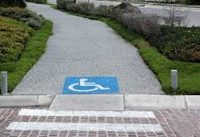
In California, sidewalks are consistently wide, usually around five feet. Almost every sidewalk has a clear curb cut, or ramp to support physically disabled individuals crossing the street. Additionally, most curb ramps are textured, and cross walks have audible signals for visually impaired individuals.
However, in Florida, sidewalks can slowly shorten overtime until they are nonexistent, or they can cease to exist altogether. Sidewalks have inconsistent curb ramps and audible signals can be broken without repair for a while. For example, when I went back to visit for the holidays, I noticed that the light on Alhambra Circle in Coral Gables was broken and was not only inaudible but also did not display the walking or wait signal.
I have also noticed that public transport is way more accessible in California. Although both states are mandated to have seats at the front of the bus for disabled individuals, in California this is taken more seriously. Not only do people respect and follow this rule, but the markings are also more obvious. There are brighter floor markings and clearer signage labeling seats as reserved.
Specifically at UCLA I’ve noticed a more inclusive protocol and overall environment. We have a Center for Accessible Education (CAE) which works with every individual who provides documentation of their disability. In the classroom, students can receive accommodations like:
- Extended time on exams and quizzes
- Reduced-distraction or alternate testing environments
- Note-taking support or access to class notes
- Assistive technology or adaptive furniture, like adjustable desks
Even outside of the classroom, there are housing accommodations. For example, students can request to have service animals in their dorm, if needed. One of the RAs in my building has a cat named Pumpkin, who has honestly become all of our emotional support pet at this point. Additionally, single-style dorms are strictly reserved for students with disabilities who prefer not to have roommates, ensuring they feel comfortable in their living space while still being included in communal dorm activities. UCLA, like much of California, has many uphill walking areas; however, students with disabilities are given access to elevators and ramps that allow them to avoid stairs and steep routes around campus.
Overall, even though California has many hills compared to Florida, which is mostly flat, it is often more accessible. This is because accessibility depends more on design and investment than on geography.